

HTA 2100H
Static vapor phase sampler
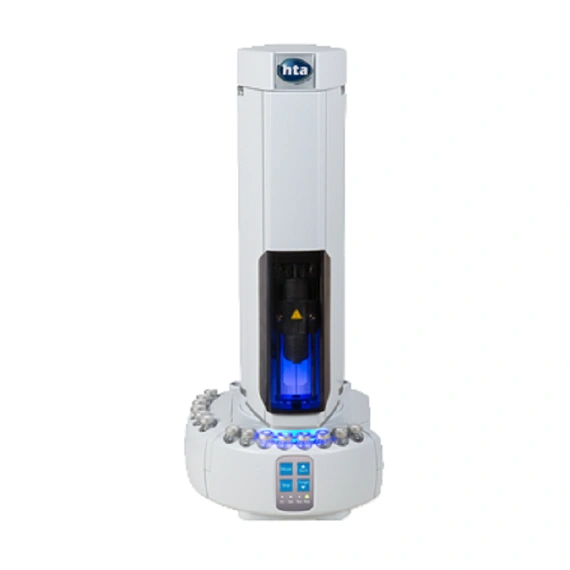
The HTA 2100H sampler is designed for the automatic preparation and injection of volatile components from liquid and solid samples into a gas chromatograph. The device is designed for laboratories where regular quantitative analysis of residual organic solvents, volatile pollutants or alcohols is required with a moderate daily load. The design is based on a carousel with 14 fixed positions, compatible with 10 or 20 milliliter vials. Unlike rotary systems with continuous rotation, this device lifts each vial individually into the heated area, which eliminates thermal effects on waiting samples and preserves the identity of…

Country of manufacture - Italy
Please check with our managers for detailed purchase conditions
HTA 2100H
Vapor phase sampler for routine determination of volatile compounds. It processes up to 14 vials, is equipped with adjustable orbital mixing and leakproofness testing of each vial.
The HTA 2100H sampler is designed for the automatic preparation and injection of volatile components from liquid and solid samples into a gas chromatograph. The device is designed for laboratories where regular quantitative analysis of residual organic solvents, volatile pollutants or alcohols is required with a moderate daily load. The design is based on a carousel with 14 fixed positions, compatible with 10 or 20 milliliter vials. Unlike rotary systems with continuous rotation, this device lifts each vial individually into the heated area, which eliminates thermal effects on waiting samples and preserves the identity of…
Country of manufacture - Italy
Please check with our managers for detailed purchase conditions
HTA 2100H
Vapor phase sampler for routine determination of volatile compounds. It processes up to 14 vials, is equipped with adjustable orbital mixing and leakproofness testing of each vial.
Static vapor phase sampler HTA 2100H
The HTA 2100H sampler is designed for the automatic preparation and injection of volatile components from liquid and solid samples into a gas chromatograph. The device is designed for laboratories where regular quantitative analysis of residual organic solvents, volatile pollutants or alcohols is required with a moderate daily load. The design is based on a carousel with 14 fixed positions, compatible with 10 or 20 milliliter vials. Unlike rotary systems with continuous rotation, this device lifts each vial individually into the heated area, which eliminates thermal effects on waiting samples and preserves the identity of incubation conditions for all samples in the series. The samples are heated in a single-position thermostat. Operating temperatures are set in the range from 40 to 150 degrees Celsius, the holding time is programmable from 0 to 999 minutes. Orbital mixing with a frequency of 320 to 720 revolutions per minute accelerates the achievement of phase equilibrium between the sample and the gas phase above it. The sample is delivered to the chromatograph with a heated gas-tight syringe, three sizes are available for 1, 2.5 or 5 milliliters. The temperature of the syringe is regulated independently of the thermostat heating in the same range from 40 to 150 degrees Celsius, which prevents condensation of volatile components on the walls of the needle. The gas intake and discharge rate is set from 0.5 to 100 milliliters per minute, the injection volume is programmed with an accuracy of 0.01 milliliters. Between successive injections, the syringe is automatically purged with inert gas, the number of cycles reaches 15. The built-in monitoring system checks the tightness of the closure of each vial before starting the sequence, which allows you to detect microcracks in the septum or loose fitting of the lid in advance, preventing the loss of target components. The device is connected to gas chromatographs and mass spectrometers of all vendors, servicing the front or rear injector. It takes no more than five minutes to move the sampler between the two analytical systems due to the quick-release attachment. The operator interacts with the device through a keyboard to run standard procedures or through computer software to create techniques and analytical sequences. The color-coded LED panel displays the current status: warm-up, sampling, injection, flushing, or service mode. The software package is offered in a standard edition and in a version with support for regulatory requirements.