

Acetic acid, Optima LC/MS Grade
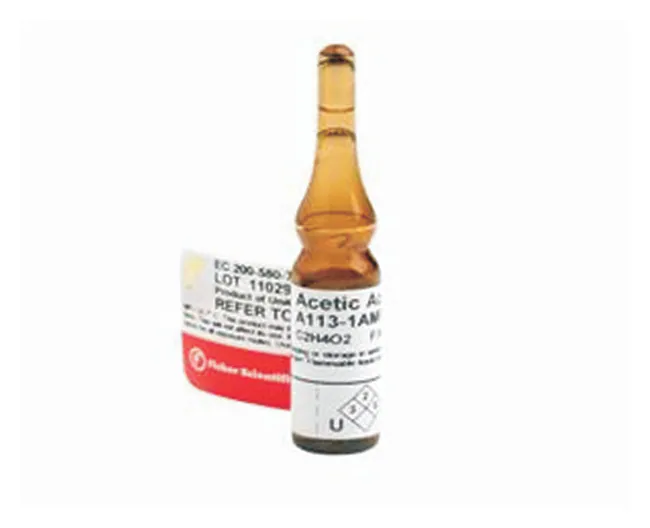
Optima LC/MS Grade acetic acid is a mobile phase modifier used in liquid chromatography and mass spectrometry. The reagent is in demand in the analysis of peptides, proteins and metabolites, where a balance between chromatographic resolution and detection sensitivity is required. By its properties, acetic acid is a weaker proton donor compared to formic acid. This difference sometimes plays a crucial role: for a number of compounds, replacing one modifier with another significantly increases the yield of protonated molecules in the ion source. Individual studies show an increase in the efficiency of peptide identification by…

Country of manufacture - USA
Please check with our managers for detailed purchase conditions
Acetic acid, Optima LC/MS Grade
Volatile organic acid for acidification of mobile phases in LC-MS. In some tasks, it provides an increase in sensitivity of up to 60 percent compared to formic acid.
Optima LC/MS Grade acetic acid is a mobile phase modifier used in liquid chromatography and mass spectrometry. The reagent is in demand in the analysis of peptides, proteins and metabolites, where a balance between chromatographic resolution and detection sensitivity is required. By its properties, acetic acid is a weaker proton donor compared to formic acid. This difference sometimes plays a crucial role: for a number of compounds, replacing one modifier with another significantly increases the yield of protonated molecules in the ion source. Individual studies show an increase in the efficiency of peptide identification by…
Country of manufacture - USA
Please check with our managers for detailed purchase conditions
Acetic acid, Optima LC/MS Grade
Volatile organic acid for acidification of mobile phases in LC-MS. In some tasks, it provides an increase in sensitivity of up to 60 percent compared to formic acid.
Acetic acid, Optima LC/MS Grade
Optima LC/MS Grade acetic acid is a mobile phase modifier used in liquid chromatography and mass spectrometry. The reagent is in demand in the analysis of peptides, proteins and metabolites, where a balance between chromatographic resolution and detection sensitivity is required. By its properties, acetic acid is a weaker proton donor compared to formic acid. This difference sometimes plays a crucial role: for a number of compounds, replacing one modifier with another significantly increases the yield of protonated molecules in the ion source. Individual studies show an increase in the efficiency of peptide identification by up to 60 percent when switching to acetic acid, while chromatographic separation remains at a high level. The product is monitored for the content of metals that are capable of forming adducts and distorting mass spectra. The residue after evaporation does not exceed 5 ppm, which confirms the absence of non-volatile impurities in the reagent. High purity guarantees long-term operation of the ion source without contamination.