

ÄKTA pure
Liquid chromatography system for purification of biomolecules
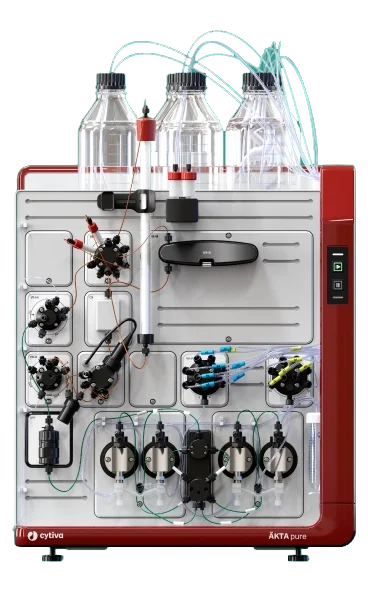
The ÄKTA pure system from Cytiva is a liquid chromatograph designed for the separation and purification of biological molecules. This equipment is widely used in laboratories engaged in protein engineering, structural biology, biopharmaceutical development, and academic research. The instrument is available in several main models, each with a different throughput. The entry-level ÄKTA pure 25 is designed for flow rates of up to 25 milliliters per minute and is suitable for most research applications. The higher-end ÄKTA pure 150 model delivers a flow rate of up to 150 milliliters per minute, enabling the use of…

Country of origin: USA
Please check with our managers for detailed purchase conditions
ÄKTA pure
A flexible chromatography system for rapid purification of proteins, peptides, and nucleic acids. Suitable for a wide range of applications, from micro- to preparative scale.
The ÄKTA pure system from Cytiva is a liquid chromatograph designed for the separation and purification of biological molecules. This equipment is widely used in laboratories engaged in protein engineering, structural biology, biopharmaceutical development, and academic research. The instrument is available in several main models, each with a different throughput. The entry-level ÄKTA pure 25 is designed for flow rates of up to 25 milliliters per minute and is suitable for most research applications. The higher-end ÄKTA pure 150 model delivers a flow rate of up to 150 milliliters per minute, enabling the use of…
Country of origin: USA
Please check with our managers for detailed purchase conditions
ÄKTA pure
A flexible chromatography system for rapid purification of proteins, peptides, and nucleic acids. Suitable for a wide range of applications, from micro- to preparative scale.
ÄKTA pure liquid chromatography system for the purification of biomolecules
The ÄKTA pure system from Cytiva is a liquid chromatograph designed for the separation and purification of biological molecules. This equipment is widely used in laboratories engaged in protein engineering, structural biology, biopharmaceutical development, and academic research. The instrument is available in several main models, each with a different throughput. The entry-level ÄKTA pure 25 is designed for flow rates of up to 25 milliliters per minute and is suitable for most research applications. The higher-end ÄKTA pure 150 model delivers a flow rate of up to 150 milliliters per minute, enabling the use of larger-diameter columns and the purification of tens of grams of target product. For ultra-small scale applications, a specialized micro model with an optimized hydraulic flow path is available. The system's design approach is reflected in its modular architecture. The base unit is equipped with additional components depending on the application: choice of chamber mixer, number of buffer inlet valves, fraction collector type, and detection options. The user can add up to 20 different accessories, including columns for switching between up to 10 chromatography columns. Detector selection depends on the UV monitor version. The basic L version features an LED detector with a fixed wavelength of 280 nm for protein detection by aromatic amino acids. The T model includes a dual-wavelength detector at 260 and 280 nm, convenient for simultaneous nucleic acid and protein detection. The flagship M version features a scanning spectrophotometer with a wavelength range of 190–700 nm, allowing selection of any wavelength or recording three signals in parallel. The instrument is controlled via UNICORN software, which provides control of all method parameters, sequence automation, data processing, and documentation in accordance with regulatory requirements. The system supports all common chromatographic techniques: affinity, ion exchange, gel filtration, hydrophobic interaction, and reversed-phase chromatography. Compatibility with organic solvents allows for analytical reversed-phase chromatography, provided special precautions are taken. The basic equipment is compact, allowing it to be placed in standard refrigerators for the purification of heat-sensitive samples. The system is available with one of four types of fractional collectors.