

Maestro AlphaMS
Maestro AlphaMS Gas Chromato-mass spectrometer
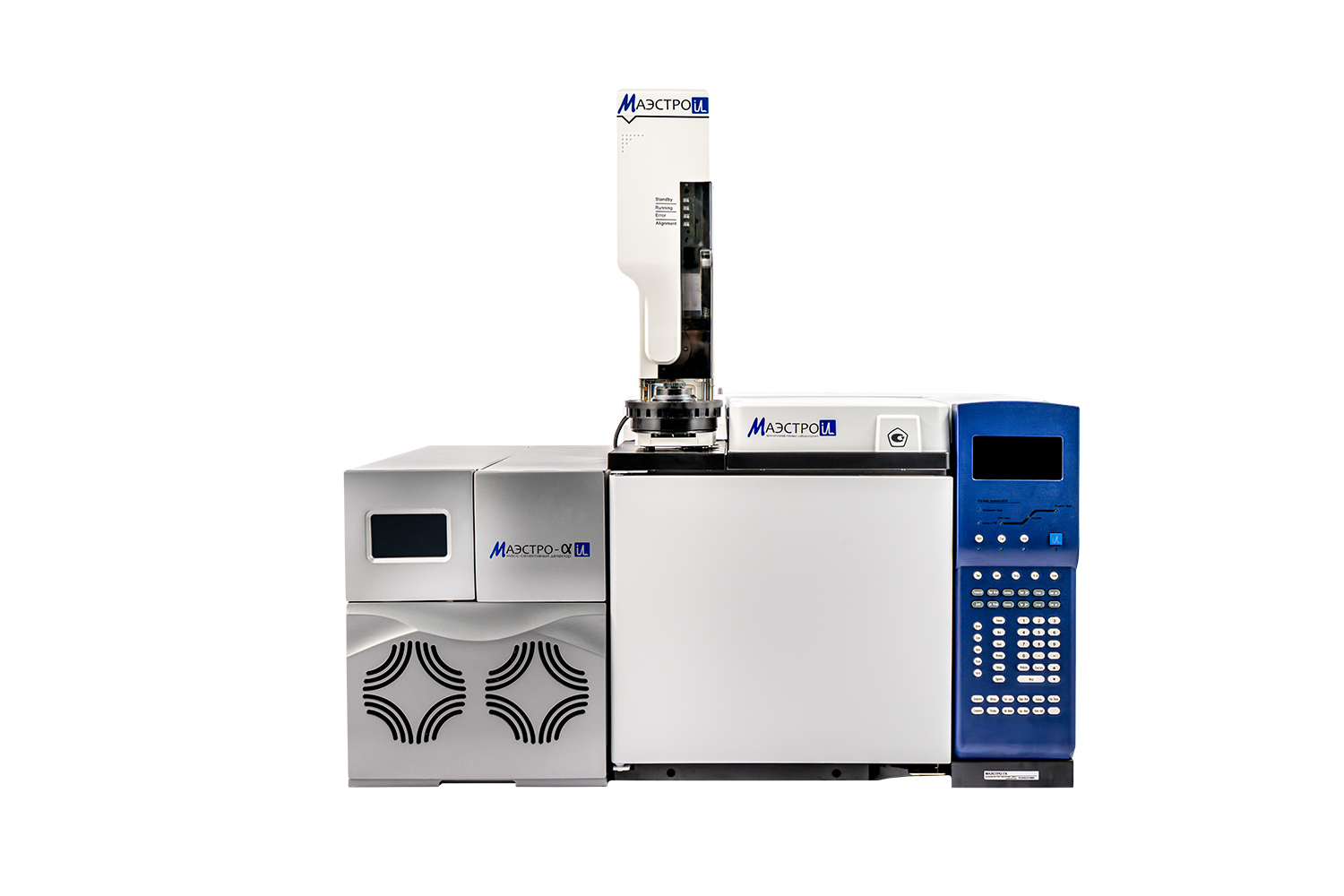
The Maestro AlphaMS chromatography-mass spectrometric system is manufactured by the Russian company Interlab and is a single-quadrupole instrument designed for the qualitative and quantitative analysis of organic compounds in complex matrices. The equipment is listed in the State Register of Measuring Instruments under the number 68965-17, has the registration certificate of Roszdravnadzor No. RZN 2020/11167 and is included in the register of Russian radio electronic products under the number 10640065. A design feature of the device is a new type of inert ion source based on ceramic, which provides high ion currents and stable operation…

Country of manufacture - Russia
Please check with our managers for detailed purchase conditions
Maestro AlphaMS
Russian quadrupole gas chromato-mass spectrometer for accurate analysis of organic substances. It is suitable for ecology, medicine, food industry and quality control.
The Maestro AlphaMS chromatography-mass spectrometric system is manufactured by the Russian company Interlab and is a single-quadrupole instrument designed for the qualitative and quantitative analysis of organic compounds in complex matrices. The equipment is listed in the State Register of Measuring Instruments under the number 68965-17, has the registration certificate of Roszdravnadzor No. RZN 2020/11167 and is included in the register of Russian radio electronic products under the number 10640065. A design feature of the device is a new type of inert ion source based on ceramic, which provides high ion currents and stable operation…
Maestro AlphaMS Gas Chromato-mass spectrometer
The Maestro AlphaMS chromatography-mass spectrometric system is manufactured by the Russian company Interlab and is a single-quadrupole instrument designed for the qualitative and quantitative analysis of organic compounds in complex matrices. The equipment is listed in the State Register of Measuring Instruments under the number 68965-17, has the registration certificate of Roszdravnadzor No. RZN 2020/11167 and is included in the register of Russian radio electronic products under the number 10640065. A design feature of the device is a new type of inert ion source based on ceramic, which provides high ion currents and stable operation in the analysis of complex biomaterials. The S-filter creates a retaining electric field that filters out neutral particles and reduces background noise. Two types of detectors are used to register ions — an electronic multiplier and a photoelectronic multiplier with the ability to switch automatically. The mass analyzer is designed according to a quadrupole scheme and registers ions in the range of up to 1200 atomic mass units. The scanning speed exceeds 20,000 atomic mass units per second, which makes it possible to correctly describe narrow chromatographic peaks. The sensitivity of the device in full scan mode is a signal-to-noise ratio of more than 1,500 to one for octafluoroephthalene with a mass charge of 272. In the selected ion monitoring mode (SIM), the detection limit is less than 10 femtograms of octafluoroaphthalene, and the linear dynamic range reaches 6.5 orders of magnitude. The stability (drift) of the mass axis does not exceed 0.1 atomic mass units for 48 hours of continuous operation. The vacuum system includes turbomolecular pumps with a capacity of 75 and 300 liters per second. The device is equipped with a built-in uninterruptible power supply, which ensures autonomous operation for up to 40 minutes when the external power supply is turned off. The system is controlled both from a computer and from a built-in touchscreen that is sensitive to touch in laboratory gloves. The manufacturer offers automatic equipment qualification protocols — OQ, IQ and PV. The device supports operation with hydrogen as a carrier gas, which is important in conditions of helium deficiency and reduces operating costs. The Russian-language software includes tools for automatically creating SIM methods (SIM Wizard), calculating the scan time for each ion (i-Dwell Time), and post-processing data in Flexible-SIM mode. The system is actively used in scientific and industrial laboratories. Based on it, methods for microbiological analysis of microbial markers (fatty acids, sterols, aldehydes) have been developed without pre-cultivation, which reduces the analysis time to two hours. The device is also used to determine the authenticity of essential oils, detect food adulteration, screen pesticides, monitor narcotic substances and toxicants, as well as in organic synthesis to identify by-products. The instrument's mass spectrum library contains data on more than 300,000 compounds, including NIST databases and the SubMed Forensic Database.