

Analab CleanAcids
Subcurrent acid purification system
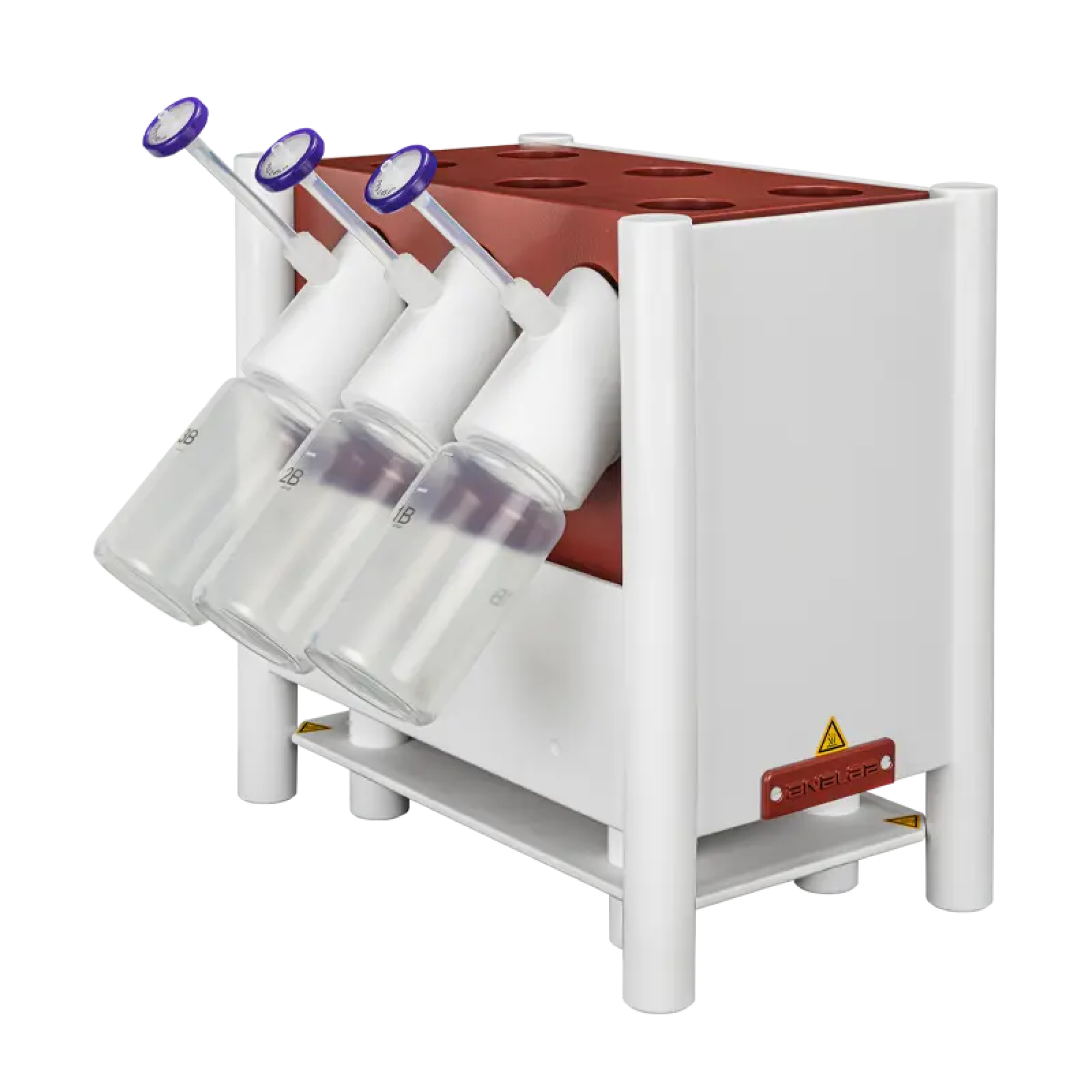
The CleanAcids system is designed for the production of ultrapure acids and reagents required for trace and trace metal analysis. The plant distills available laboratory-qualified acids into highly pure products right at the workplace, which significantly reduces the cost of purchasing expensive ultrapure reagents. The principle of operation of CleanAcids is based on the technology of sub-boiling distillation. The liquid is heated in the initial container to a temperature below the boiling point. With this gentle treatment, only the molecules of the solvent itself and volatile acids evaporate, while non-volatile impurities remain in the original…

Country of manufacture - France
Please check with our managers for detailed purchase conditions
Analab CleanAcids
A plant for distilling acids without boiling to obtain highly pure reagents. It allows to purify nitric acid, hydrochloric acid, hydrofluoric acid and ammonia.
The CleanAcids system is designed for the production of ultrapure acids and reagents required for trace and trace metal analysis. The plant distills available laboratory-qualified acids into highly pure products right at the workplace, which significantly reduces the cost of purchasing expensive ultrapure reagents. The principle of operation of CleanAcids is based on the technology of sub-boiling distillation. The liquid is heated in the initial container to a temperature below the boiling point. With this gentle treatment, only the molecules of the solvent itself and volatile acids evaporate, while non-volatile impurities remain in the original…
Country of manufacture - France
Please check with our managers for detailed purchase conditions
Analab CleanAcids
A plant for distilling acids without boiling to obtain highly pure reagents. It allows to purify nitric acid, hydrochloric acid, hydrofluoric acid and ammonia.
Subcurrent acid purification system Analab CleanAcids
The CleanAcids system is designed for the production of ultrapure acids and reagents required for trace and trace metal analysis. The plant distills available laboratory-qualified acids into highly pure products right at the workplace, which significantly reduces the cost of purchasing expensive ultrapure reagents. The principle of operation of CleanAcids is based on the technology of sub-boiling distillation. The liquid is heated in the initial container to a temperature below the boiling point. With this gentle treatment, only the molecules of the solvent itself and volatile acids evaporate, while non-volatile impurities remain in the original vessel. The resulting ultrapure vapors condense in the cooling chamber, flowing into a separate receiver. The design completely eliminates the use of metal components in contact with acids. The surface of the graphite heating unit and the protective covers have a PFA coating that is resistant to the corrosive effects of vapors of any inorganic acids. The manufacturer produces five main modifications, differing in the number of simultaneously cleaned samples and the volume of the receiving tank. The CA-1.1000mL model is designed for one position with a 1000 milliliter receiver, which is suitable for laboratories with a high demand for ultrapure acids. The CA-3 series includes three-position systems with 500 or 125 milliliter receivers. The multi-position models CA-6.125mL and CA-12.125mL are designed for 6 and 12 receivers with a volume of 125 milliliters, respectively, which is ideal for simultaneous preparation of various types of acids or processing of a large number of samples. The temperature controller is made in a remote design with a PFA-sheathed cable, which allows it to be placed outside the fume hood, protecting the electronics from an aggressive atmosphere. The control is carried out through a programmable controller that supports the creation of multi-stage temperature profiles. The distillation rate ranges from 10 to 35 milliliters per hour, depending on the configuration and type of acid being purified. The unit is compatible with various reagents, including nitric, hydrochloric and hydrofluoric acids, ammonia, and hydrogen peroxide.