

Thermo Scientific DNAPac PA200
Column for anion exchange chromatography of oligonucleotides
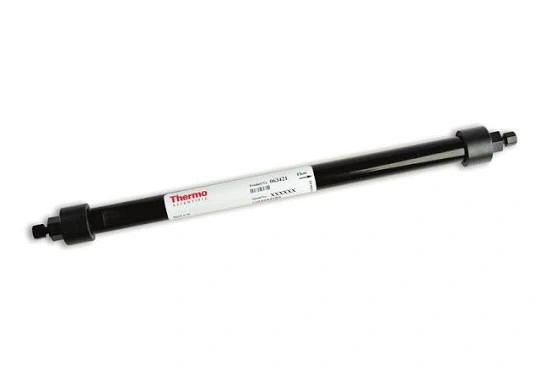
The Thermo Scientific DNAPac PA200 chromatographic column is designed for the anion exchange separation of synthetic oligonucleotides used for therapeutic purposes and molecular diagnostics. The device is in high demand in the biopharmaceutical industry for quality control in the synthesis of oligonucleotide drugs, as well as in research laboratories developing diagnostic primers and probes. The sorbent is built on a two-level agglomerated structure. The core consists of spherical particles of an ethylvinylbenzene-divinylbenzene copolymer with a high degree of crosslinking of 55 percent and a diameter of 8 micrometers. Latex nanoparticles with a diameter of 130…

Country of manufacture - USA
Please check with our managers for detailed purchase conditions
Thermo Scientific DNAPac PA200
A specialized anion exchange column for high-resolution separation of oligonucleotides up to 60 bases long. Distinguishes between target sequences and short failure sequences due to the unique agglomerated latex technology.
The Thermo Scientific DNAPac PA200 chromatographic column is designed for the anion exchange separation of synthetic oligonucleotides used for therapeutic purposes and molecular diagnostics. The device is in high demand in the biopharmaceutical industry for quality control in the synthesis of oligonucleotide drugs, as well as in research laboratories developing diagnostic primers and probes. The sorbent is built on a two-level agglomerated structure. The core consists of spherical particles of an ethylvinylbenzene-divinylbenzene copolymer with a high degree of crosslinking of 55 percent and a diameter of 8 micrometers. Latex nanoparticles with a diameter of 130…
Country of manufacture - USA
Please check with our managers for detailed purchase conditions
Thermo Scientific DNAPac PA200
A specialized anion exchange column for high-resolution separation of oligonucleotides up to 60 bases long. Distinguishes between target sequences and short failure sequences due to the unique agglomerated latex technology.
Column for anion exchange chromatography of oligonucleotides Thermo Scientific DNAPac PA200
The Thermo Scientific DNAPac PA200 chromatographic column is designed for the anion exchange separation of synthetic oligonucleotides used for therapeutic purposes and molecular diagnostics. The device is in high demand in the biopharmaceutical industry for quality control in the synthesis of oligonucleotide drugs, as well as in research laboratories developing diagnostic primers and probes. The sorbent is built on a two-level agglomerated structure. The core consists of spherical particles of an ethylvinylbenzene-divinylbenzene copolymer with a high degree of crosslinking of 55 percent and a diameter of 8 micrometers. Latex nanoparticles with a diameter of 130 nanometers are agglomerated around the core with grafted quaternary ammonium groups providing a strongly basic anion exchange function. This design creates a thin functional layer on the surface of the non-porous core, which ensures rapid mass transfer and high resolution when separating large biomolecules. The speaker is available in two versions. The standard version uses 8 micrometer particles, can withstand pressures up to 4,000 psi, and is compatible with classic high performance liquid chromatography devices. The DNAPac PA200 RS (Rapid Separation) version is based on 4 micrometer particles, is designed for pressures up to 10,000 psi, and is optimized for use on bioinert ultra-high performance liquid chromatography systems. The RS-version case is made of stainless steel with a PEEK-lined coating, which eliminates the contact of analytes with metal surfaces. The column is stable in the pH range from 4 to 10 when working with conventional eluents, and when using equimolar salt concentrations, the range expands to a pH of 2.5–12.5. The upper operating temperature limit is 85 degrees Celsius, but the manufacturer does not recommend using high temperatures and high pH values at the same time, as this accelerates the degradation of the sorbent. The column is fully compatible with organic solvents in concentrations up to 100 percent. The separation of oligonucleotides is based on their negative charge: each phosphodiester bond contributes one negative charge, so longer sequences are eluted later with a gradient increase in salt concentration. The column is able to distinguish between target sequences and short sequences-failures — impurities formed during incomplete synthesis. A resolution of up to 67 components in a mixture of oligonucleotides with a length of 12 to 60 bases is achieved in 12-14 minutes on a 4×250 mm column.